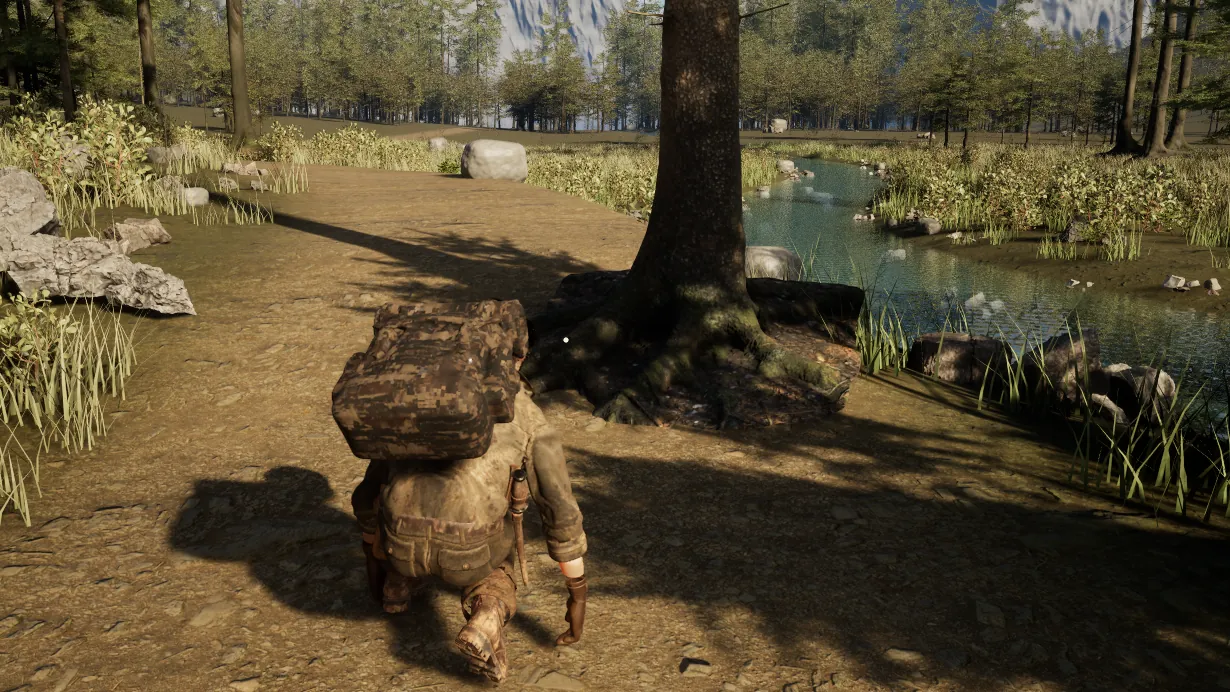
The hardest moment in a walk is the end of it. Between October 4 and October 7 more than sixty notes went into what the survivor’s legs do when you let go of the keys: the last step, the foot planting, the knee settling and the idle taking over. Most of them were experiments, measured and then left switched off.
The visible fault was a jitter: at a stop the legs shuddered or the knee snapped as the standing idle took over. Finding the cause was slow because each candidate fix improved one thing and broke another. One cut a recorded restart jump from 32 cm to 1.45 cm. Another cut the knee spikes at the first and last stop by 33 and 27 percent while the second stop stayed bad. Several looked better in one frame and made the knee jumps worse over the whole clip, and were turned off.
What reached the normal game came in small pieces. Late on October 4 the correction that keeps feet on uneven ground began to blend at the leg joints, reducing knee snaps as a nearly straight leg settles. On October 5 starting to walk again halfway through a stop began to keep the motion it had instead of jumping to a fresh walk, and the relaxed idle began as the finishing step landed. On October 6 the final foot placement began while you slow down. On October 7 a run stopped with the mid-stride foot finishing its step instead of freezing in the air.
Alongside, a body that balances on its own physics was measured on a test bench. One fix to how a single planted foot reports back cut how far its center of mass drifted after a push from 65.1 cm to 3.0 cm. It still cannot take a recovery step, and it stays off in the game.
The four days come down to a ratio: a few changes landed, many were measured and set aside, and each one set aside was a fix that would have made a different part of the stop worse.