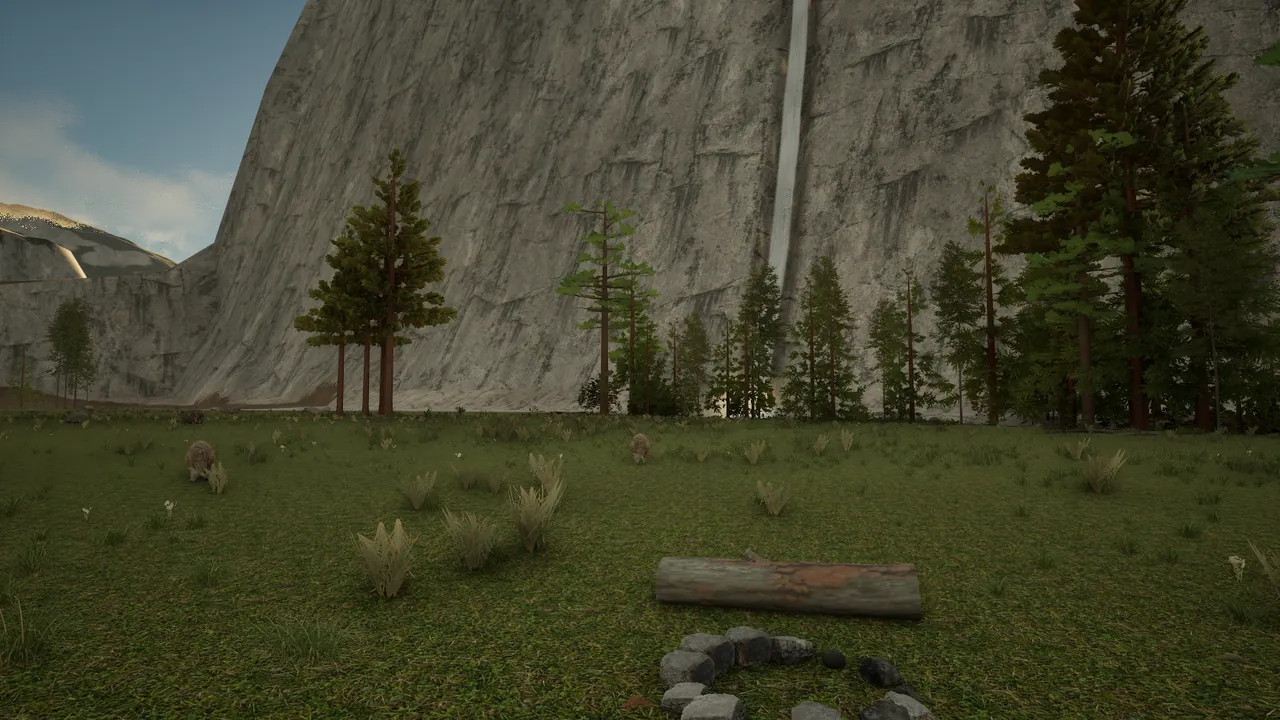
A new world starts with empty hands, beside a camp that has a ring of stones for a fire. On November 6 the play logs began to note where a player walks every 5 s, so that the first fifteen minutes of a play could be measured. With it came a numbered list of the places where that quarter hour stalled. The first fire was first on it, and picking things up was fourth.
Early on November 7 the fire, until then worked with R, became all E, the key that picks things up. A tap on the empty ring put an armful of 8 sticks from the pack into it and kept one back for the drill. A second tap knelt the player to the fire drill. Nine sticks were left lying at the ring as part of the camp.
The same round corrected a reading of the logs. A log from a playtest a few days earlier held nine presses of E that had been read as a player taking the ring apart. They were picking up granite chips mined from a boulder about 22 m away. Nothing in the game lets E dismantle a ring, so nothing there was changed.
Picking up was a matter of aim. E took only what sat inside a narrow 28-degree cone around the look. From November 7, when the cone is empty, E takes the item closest to the look, up to 75 degrees off it. Play logs read on November 12 gave the difference: 63 of 77 presses on foot had missed before the change, and 9 of 40 since. Of those 9, 8 had nothing near: the player had pressed on after a pile was emptied, and the game had answered with nothing. Since November 12 the hand reaches toward where you look and a soft generated rustle of a sleeve plays.
Presses of E on foot that picked up nothing
Play logs read on November 12
- Before the change63 of 77
- Since the change9 of 40
The older check of the R drill turned up a second problem on November 7. In first person the hands were drawn 27 to 47 cm from the spindle, which turned on its own. The check had last passed in mid-October, and the first-person body work since was the likely cause.
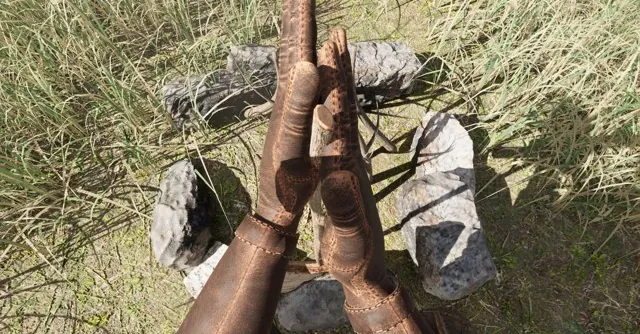
It was fixed on November 12, in two rounds. The first gave the drill its own kneeling clip, brought both hands to the shaft and removed hands that crossed in an X. The cause: gathered sticks are held automatically, so the right hand’s fingers were still wrapped around a hidden stick. The drill now puts the held tool away and lays the fingers flat along the shaft. The spindle, which had been the lay’s crooked stick scaled down to a line 0.25 cm thick, became the straight gathered stick, about 2 cm thick. A little over an hour later the deep squat became a kneel on both knees, as in an 1870s photograph of a hand drill, and the first-person look stopped short of straight down, so a palm shows on either side of the shaft. The hands sit 2.7 to 4 cm from it.
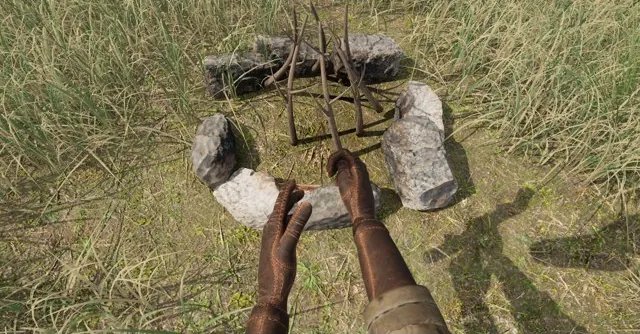
All of this still left the ring empty until a player filled it. On November 13 the fire was laid for them. The ring, about 4 m ahead of where a new player wakes, held a cold lay of 8 sticks, with 3 sticks, tinder and chert beside it, and in a check run taps of E alone lit it 15 s after the first tap. Seen from where a player wakes, though, the lay was only a small dark cone of sticks above knee-high grass. The ring stones and the kit beside it were hidden.
The cause was in the step that clears grass around a fire ring. It chose which groups of grass to hide by each group’s stored outline, and for 75 of 85 groups that outline had not been set yet, so it hid none. It now chooses by block of ground: 37 are hidden, and none is left within 1.6 m of the ring. About two and a half hours after the lay, the ring sat on a trampled bare patch, a 2.5 m disc, with the stones and the laid sticks in view from the waking spot.
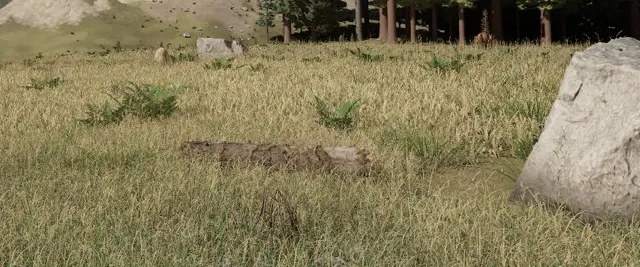
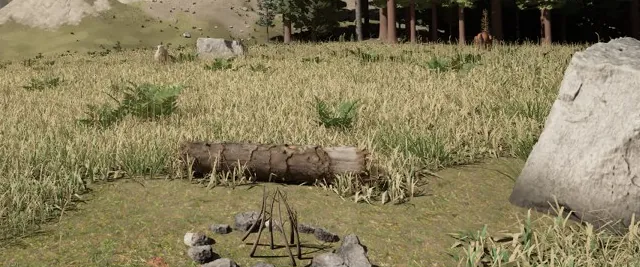
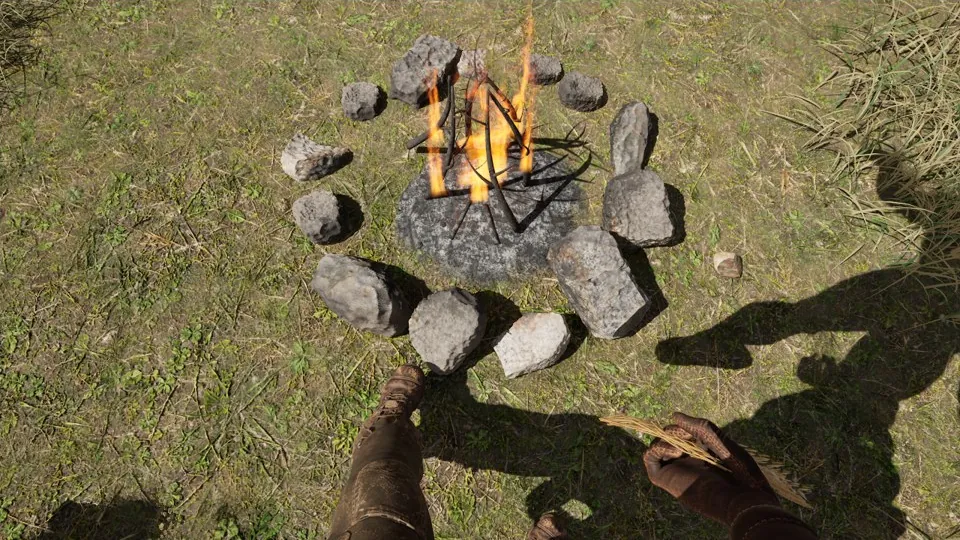
The pickup change has been measured on logged play; the laid ring on its bare patch, so far, only in check runs. The edge of the clearing is fairly sharp, and the kit beside the ring is still hard to make out from the waking spot.