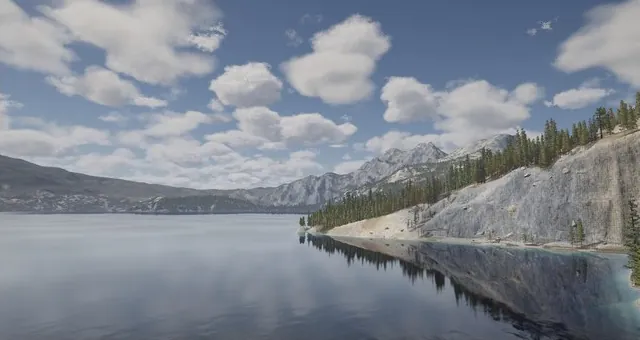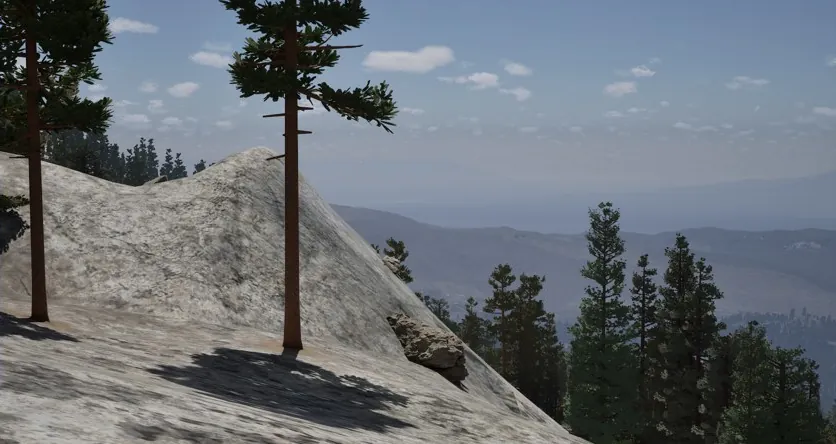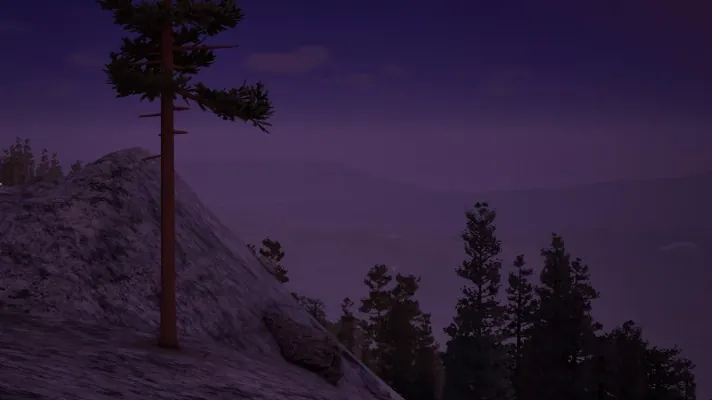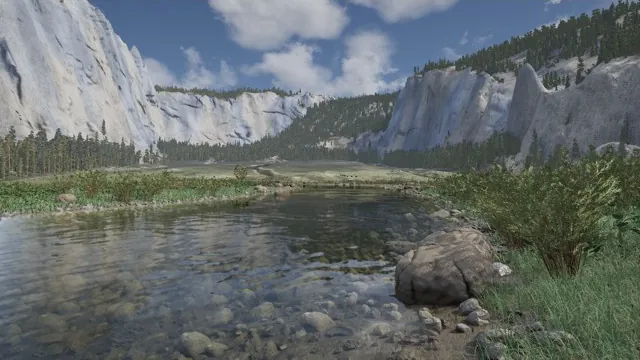
The daytime picture uses a camera’s daylight white balance, 5800 K instead of 6500 K. The sky is a deeper blue, and sunlit granite and far forest lose their yellow-tan cast and read closer to the neutral gray of photographs. Brightness is unchanged.
Haze, fog, clouds, bloom and the tone curve were each tried first and barely moved the color of the sky. The white point did. Sunlight is already warmed by the air on its way down, and the old white point drew it tan and grayed the sky.
A day later the balance began to follow the sun. Under a low evening sun, sunlit granite stays near neutral instead of going beige. Golden hour keeps its warmth, though less of it than before, and dusk is untouched. The shift eases in over 25 s.
Still off: the sky in photographs is deeper still. At a low sun, rock lit mostly by the sky reads bluer than it should, and at golden hour one view’s sky and lake turned a little more cyan.