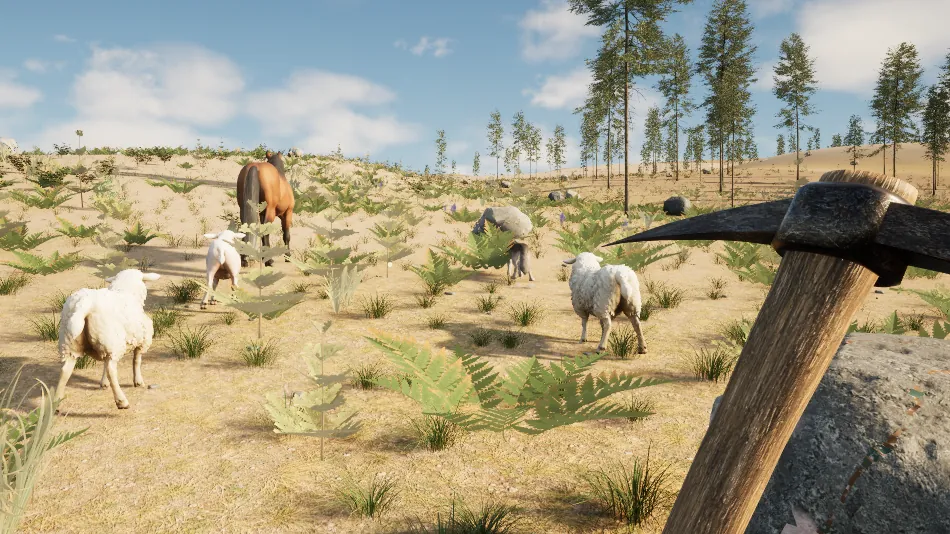
A playtest video described on October 28 showed the game drawing 26 to 37 frames a second. A new Steady setting made the frames arrive evenly, not faster: on one 144 Hz screen it held 28.8 or 24 frames a second that day. The next day’s note stated the goal: 60 to 144 frames a second, with the same look.
The first fix, earlier on October 28, had gone after the long stalls. Each outer tile, 16 km of distant mountains, was being rebuilt on the game’s main thread at 120 to 210 ms a tile, every time the player crossed a 2 km line. With the tiles built in the background, a 700 m gallop went from 45 frames over 100 ms to 8. The typical frame stayed at about 38 ms: the graphics card set the pace.
On October 29 the work turned to shadows. Trees stopped swaying past 250 m and meadow grass past 120 m, where the sway is under a pixel. The sun began to turn in steps of 0.1 degrees, about one every 3 s, so shadows could be kept between steps. Shadows fell from 14.3 to 9.8 ms a frame, about a third, and the graphics card’s whole frame from 40.3 to 35.4 ms. Both sides came from one 2 km gallop that switched the changes off and on every 5 s, so they shared a machine.
One of those savings showed. By November 5 the long shadow edges of far hills were hopping every few seconds at dawn and dusk, and the sun’s steps became 0.05 degrees, at about the same cost.
October 30 belonged to the upscaler, which draws fewer pixels and rebuilds the picture. With DLSS drawing at about 67 percent scale, one test card spent 45.2 ms on a frame instead of 57.6 ms, and side by side only the grass underfoot looked a touch softer. DLSS became the default on RTX cards, and by evening one machine was losing the graphics card on its third frame in 5 of 7 starts. The default went back to TSR. A cause was named, 10 of 10 starts came up clean, and DLSS returned. Then the first start after a reboot lost the card anyway, and DLSS came off again under a rule: back only with a stated cause and a clean run of cold starts.
The stated cause arrived on November 4. Lighting work had been running on a second queue of the graphics card beside the shadow pass, and on one test card the overlap could read a broken buffer. Moved to the main queue, it cost no frame time, and a stress test that had lost 6 of 15 starts lost 0 of 15. On normal settings the fault had come about 1 start in 60, so the default stayed on TSR while that proof ran. DLSS returned on November 5, after 24 of 24 cold starts of the packaged game.
Cold starts that lost the graphics card
Stress test on one test card
- Before the fix6 of 15
- After the fix0 of 15
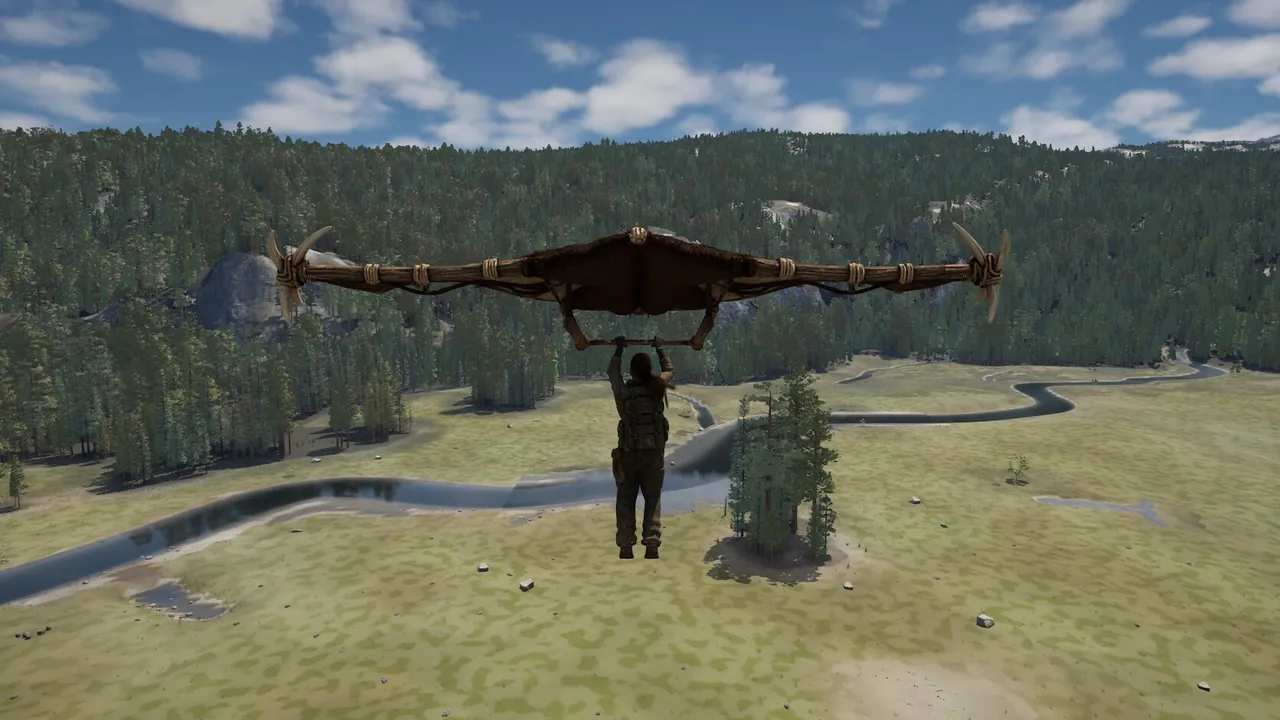
The same day a playtest met a glide over dense forest and a lake that fell to about 4 frames a second. On a 400 m route there the graphics card averaged 166.6 ms a frame, and 389 frames took longer than 100 ms. The lighting, which captures the scene for its own use, had been capturing every tree at its detailed model. Capturing each tree’s simpler crown model instead changed the picture by 1.5 on a scale of 255 and brought the same route to 48.6 ms, or 33.7 ms on a fresh world, with 4 frames over 100 ms.
Milliseconds a frame
Shadows, on a 2 km gallop
- Before14.3 ms
- After9.8 ms
The graphics card’s whole frame, same gallop
- Before40.3 ms
- After35.4 ms
Upscaler drawing at about 67 percent scale, one test card
- Without DLSS57.6 ms
- With DLSS45.2 ms
Glide over dense forest and a lake, 400 m route
- Before166.6 ms
- After48.6 ms
None of this reached the goal. Two play sessions in November changed frame rate 74 times in 22 minutes and 40 times in 15. A replay of both logs through the pacing rules in the build, noted on November 14, averaged 36.8 and 37.9 frames a second. Revised rules, built and left switched off, cut the changes by only 10 to 13 percent in that replay and were not run in the game. The changes came from the work: a frame took 20 to 24 ms in open ground and 28 to 38 ms in vegetation or while new ground arrived.
Frame generation reached Settings the same day, also switched off. On Auto it engages only while the game holds exactly half the screen’s rate, 72 drawn for 144 shown. It had not been seen producing a frame: the card it was checked on does not support it. Its added delay was unmeasured.