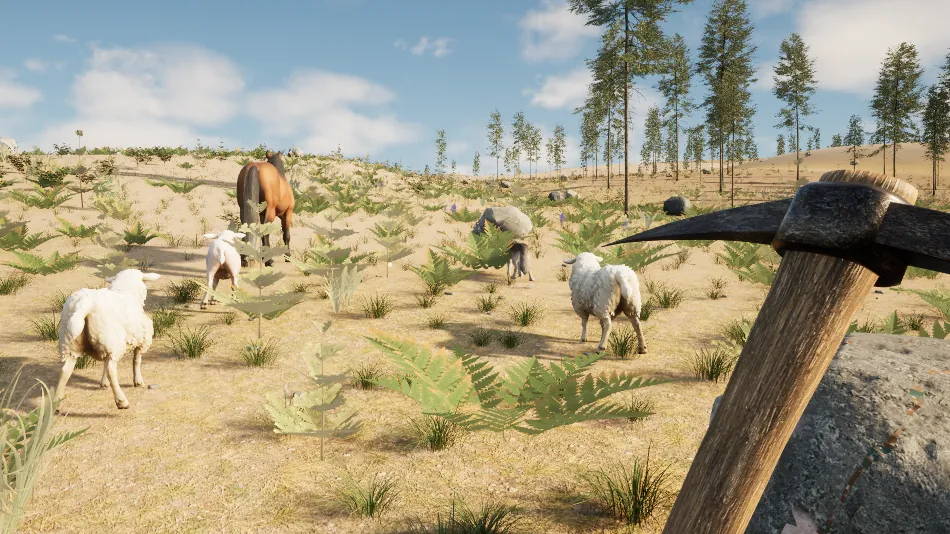
Changes to the world are judged from review captures: a fixed camera, a fixed seed and a picture taken once the game says it is ready. On September 14 a capture that had already passed was run again on the same build and seed, only to confirm the frame could be reproduced. One run showed the familiar hillside with ferns, pines and boulders. The other showed pale dunes running to the horizon, with the same animals standing in them.
Both frames had passed every automated check. The checks waited until nothing was left compiling, but ground that has not arrived yet has nothing to compile. An unfinished world looked exactly like a ready one. Counting the terrain actually being drawn showed the scale of it: about 52,000 vertices in the bad frame, about 62,000 in a frame that had already been accepted as good, and about 605,000 once loading had really finished.

So every capture from the night before was a picture of a partly loaded world, including before-and-after pairs that had already been reviewed. The capture step now waits until the visible ground stops growing across several samples before it takes the picture.
That wait is better, but it is not proof. A pause in loading also looks like ground that has stopped growing: one pair of test runs finished with the same number of terrain pieces and nearly twice the geometry. Important comparisons are now taken twice and their counted geometry compared. If two runs of one shot differ by a large factor, at least one of them was taken too early.