The first campfire is not a timer counting down. Its fuel follows a burn law, so the amount left at any moment is one calculation from the mass at its last change and the time since. The server never has to step the fire forward, every machine computes the same remaining fuel, and a machine that joins late can show a fire already half gone without replaying anything.
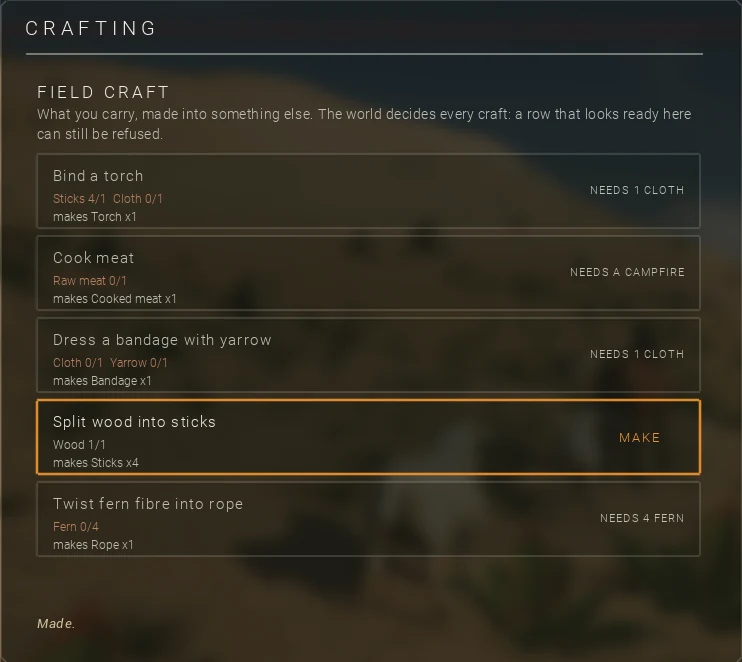
The first draft was placed from a campfire kit that did not exist anywhere in the item list, so no player could ever have built one. Wood does exist, and a felled tree pays four pieces of it, so a campfire is now four wood. Its fuel is the real weight of that wood: four pieces at 1.5 kg make a 6 kg fire.
An age, not a birthday
The world clock pauses while the game is paused or closed, which is right: nobody expects a fire to burn out while the game is shut. But that clock also restarts at zero every time a world loads. A fire saved half an hour into a session carried a start time the new clock would not reach for another half hour. Loaded, it would have sat lit and frozen, burning nothing, until the clock caught up. The fire now saves how long it has been burning, which means the same thing on any clock, including a joining player’s.
Placing fires turned up one more limit. Positions were stored in millimeters, which only reach about 2,147 km from the world’s origin, and the player spawns about 4,111 km out. The scheme could not name the ground anyone was standing on. Centimeters reach far enough.
Warmth is modeled as real radiated heat. At one meter a player receives roughly 124 to 195 watts per square meter, and at four meters almost nothing. More wood makes a fire last longer rather than burn hotter, because above about 2 kg it is limited by air.