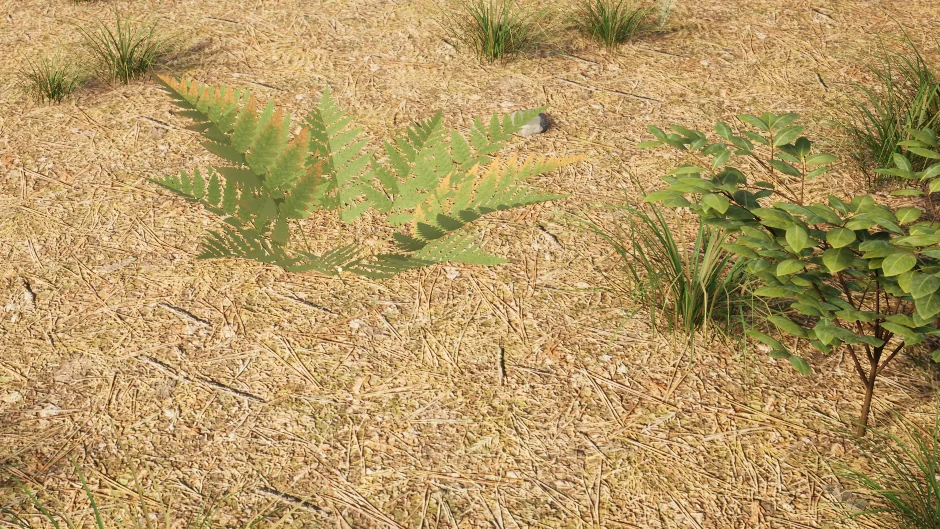
A change to how the world classifies ground reclassified the start hillside from conifer forest into juniper woodland and chaparral. That is closer to what a dry, sun-facing slope in the Sierra would be. The view got emptier, even though the generator was now placing more vegetation than before.
Only three of the game’s seven plant species had models attached. The other four were placed in every chunk and silently skipped when it came time to draw them. Manzanita, the chaparral shrub and the most numerous plant the generator places anywhere, was placed 2,628 times across twelve test chunks and drawn zero times. A log line that reported three species bound turned out to be a fixed number typed into the message, not a count. While every site was classified as forest, only forest species were ever needed, so the missing models and the misleading log hid each other.
The wrong side of every hill
Looking into why manzanita barely grew even where it belonged turned up an older bug. The term that rewards sunlight had its direction inverted since it was written: north-facing slopes were treated as sunny and south-facing slopes as shaded. Shade-tolerant white fir was being sent into the sun and sun-loving manzanita into the shade, on every hill.
With the sign fixed, manzanita placed on its home ground went from 1,010 to 21,189 plants, and black oak from 51 to 253. In a twelve-chunk test area, ponderosa pine and white fir fell by 15 and 17 percent, because they had been growing on the wrong slopes. Two species still have no model at all, and the chaparral is sparse. Those are content that still needs to be made, and the gap is not being hidden by turning up density.