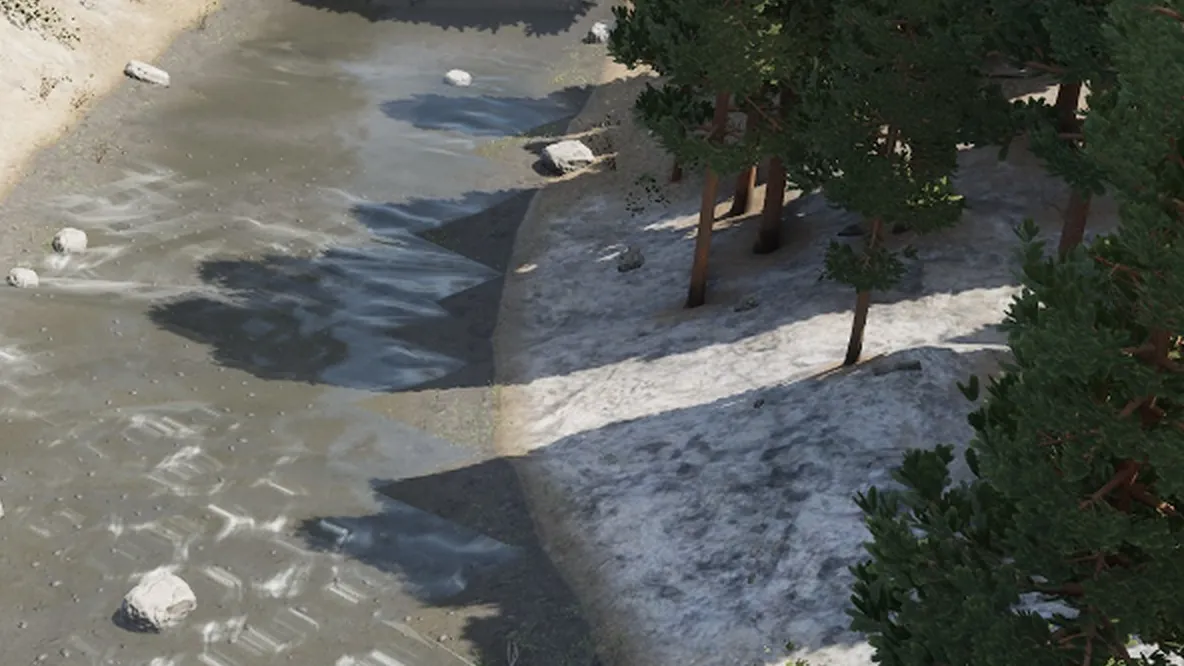
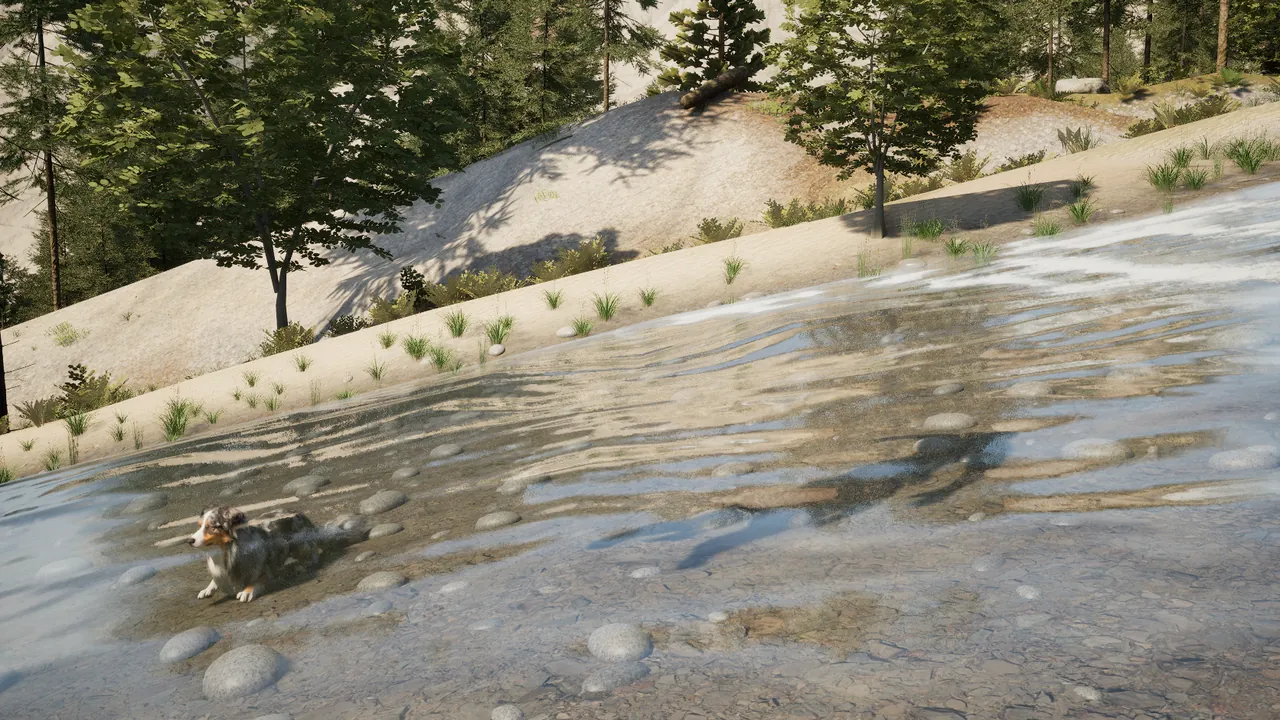
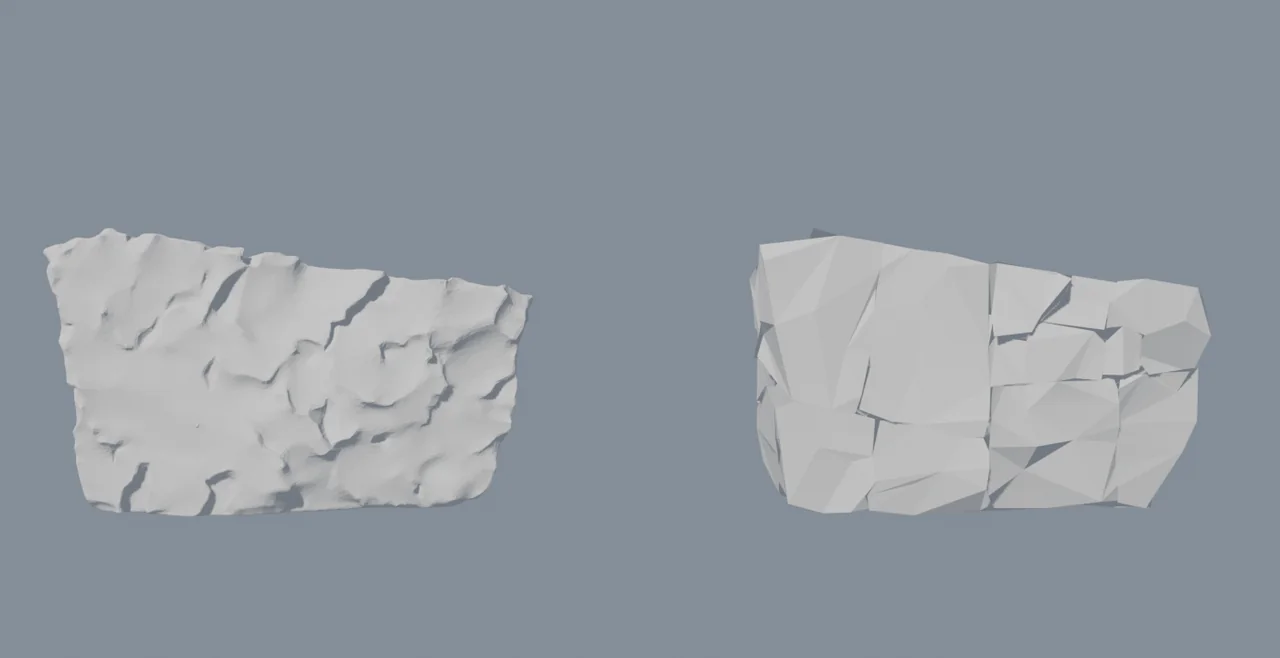
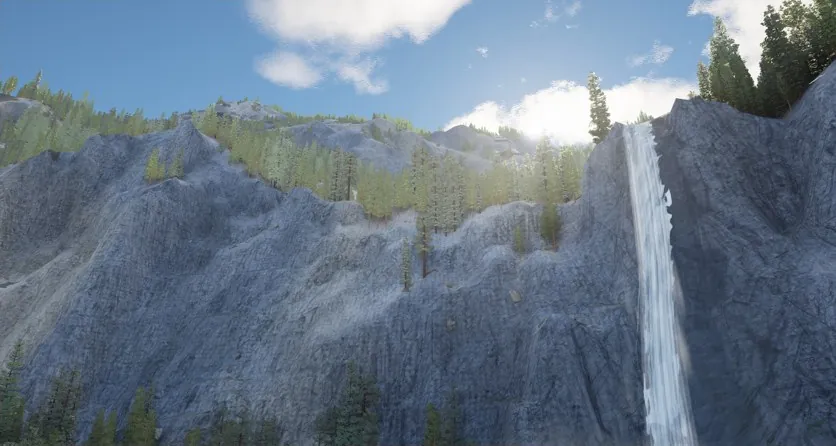
Early on November 4 a playtest stopped at a tall waterfall and judged it harshly. The falling water read as grain, and the granite beside it carried big black shapes that looked like hard shadow. By November 14 the falling water was being rebuilt from measurements, most of the rebuild switched off.
The black shapes were not shadow. The river’s water level at the brink was being carried down onto the cliff below it, so the ground drew those patches of wall as deep river bed. The grain was the water itself, drawn as a see-through stipple. It became solid water with real gaps.
Then came ten rounds on the fall itself, landing over about ten hours, most of them picking up what the round before had left rough. A flat white board became white ropes with darker, glassy water between them. At the foot, where water had lain on the slope as dark shards, the fall got a churning white core, then a plunge pool worn into the ground. Foam that sprawled more than 50 m down the creek, or stood up the wall as a white spike, was held round the impact. A short second fall a few meters to the left was the same creek counted twice.
Two faults resisted. A dark squiggle sat low on the curtain. The sixth round blamed plants on the lip and rocks set into the cliff, and cleared both out of the falling water. The frames still showed it. It was a loose boulder scattered onto the wall, and the seventh round took it out.
The other was the pool, which from above read as a dark square. Fading its deep color in over the bowl did not cure it, nor did sloping its back wall. The pool was being drawn on the terrain’s 4 m grid, so its bowl came out as a box. The eighth round gave it its own patch of ground at half-meter spacing, a round shore and clear green-blue water. The ninth and tenth removed dark spots dotted over the surface and white plates at the pool’s back corners, which frames proved the foot’s foam alone had drawn.
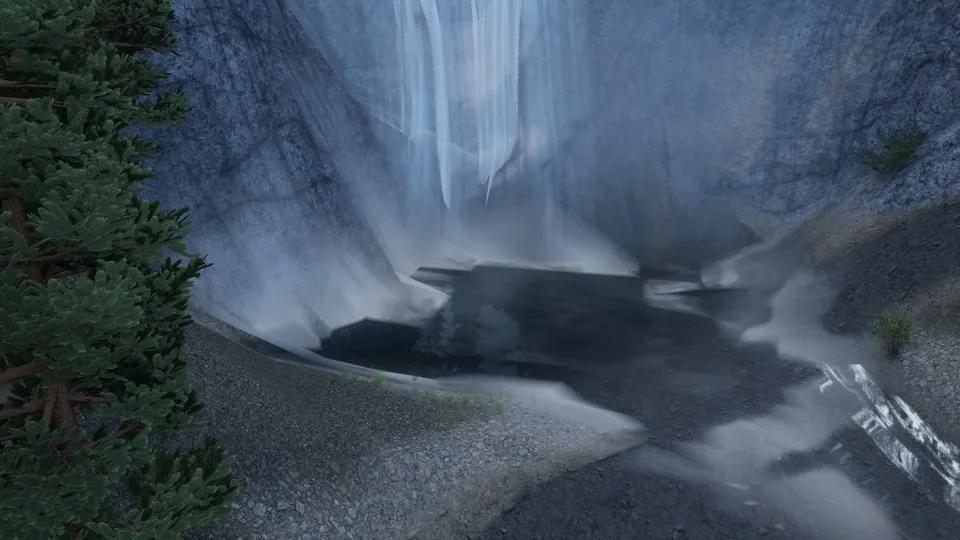
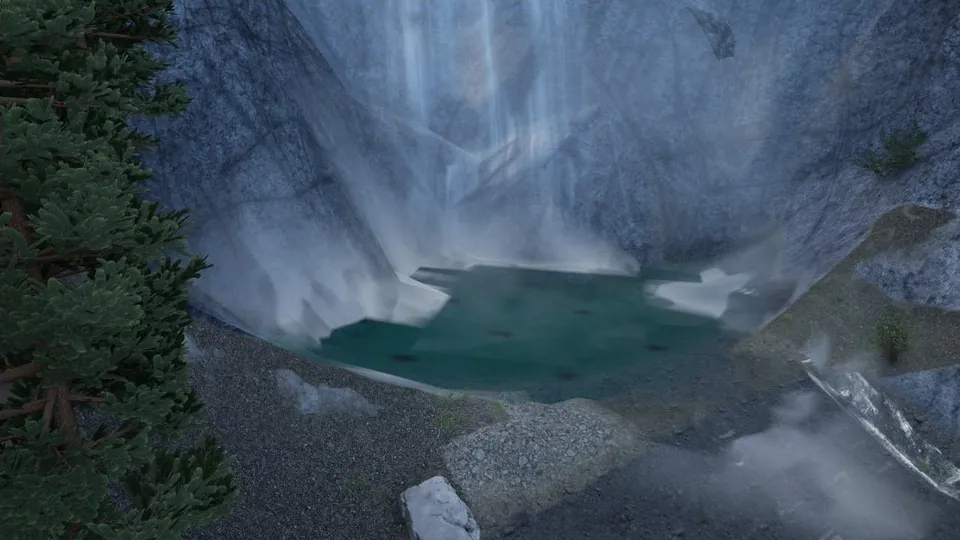
The ten rounds had been tuned on one world. On November 6 the falls around ten recent starts were checked. Most sat right. The small falls that drop off a ledge beside a bigger one did not: their white sheets dived tens of meters into the cliff and came back out, or hung a few meters off the rock. They were made to land on the rock. Four of the ten worlds had no waterfall within about a kilometer of the start.
Early on November 14 the work started again from measurement. Public-domain footage of Yosemite Falls was read for how falling water moves. Tracking the image failed on streaky water, so single columns of pixels were followed through time instead, and the method recovered the lower fall’s 98 m drop as 99.7 m on its own. There the water followed free fall to about 30 m/s at 60 m. On the upper fall the packets of water leveled off at 15 to 22 m/s. The game’s packets had been capped at 14 m/s.
The same morning explained why the fall behind one spawn camp ended half way up its wall. The point the world gave as its base sat on the lip of a 45 m step in the drawn rock, so the water, its foam and its mist all stopped there. A fall was now carried on down the drawn ground to the floor. A check found the foot on the ground and the body a pale ribbon with wavy ridges, nearly see-through up close. A new version, darker and glassy, looked like plastic with torn, hard-edged flaps, and stayed switched off. Either way it was a ribbon, not water.
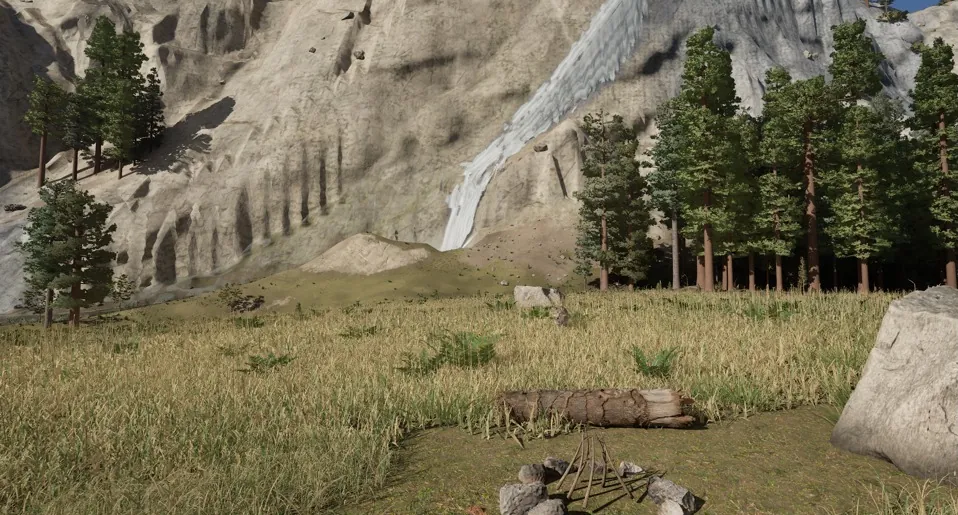
Three more changes that day each built a piece and left it off, among them water that followed the drawn rock and free-falling water that left the lip on an arc. Each came with what it had not fixed: slab water that almost disappeared up close, a column that vanished into haze. The last change of the day held the first two steps of a new design for how a fall is drawn, wet rock on the wall and a larger cloud at the foot among them. They were built, switched off, and not yet proven in motion or in shade.