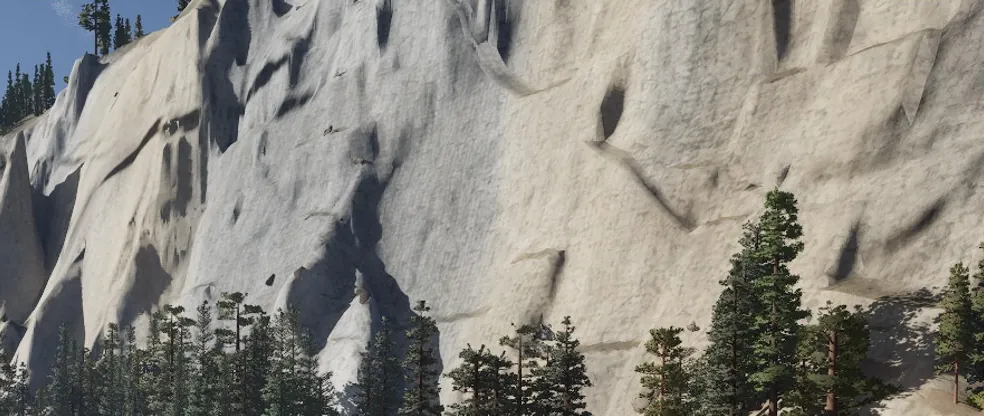
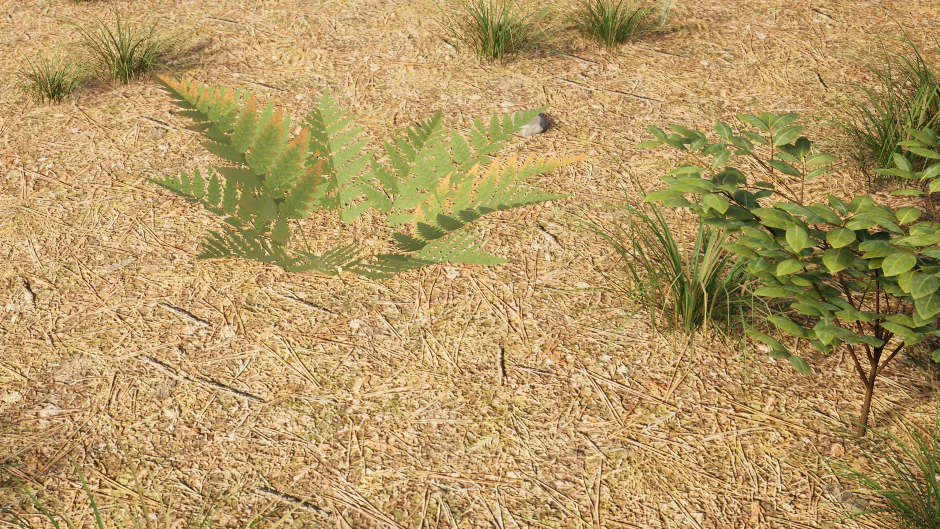
On November 4 a playtest glided past a tall granite wall with a waterfall on it and flagged big black stair-stepped slabs on the rock beside the fall. They looked like hard shadow and were not. The river’s water level at the brink had been carried down onto the cliff below it, so the ground drew those patches as deep river bed.
That fault set the pattern for the ten days that followed. The ground is stored as a map seen from above, with a point every 4 m. On a near-vertical wall one 4 m cell spans tens of meters of height, so whatever is stored that way is dragged down the face.
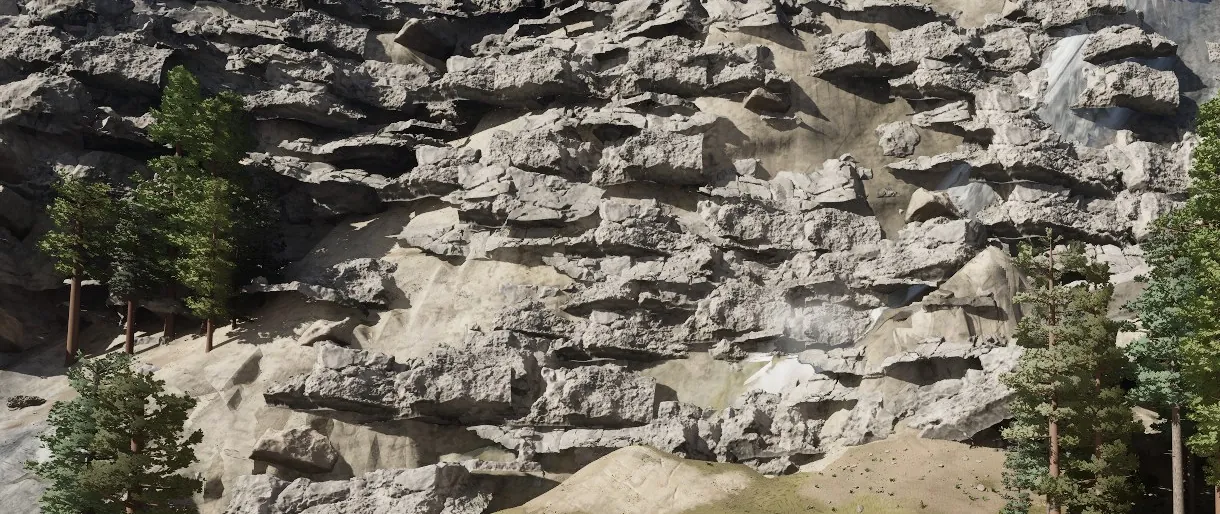
The wall also got real shape that day. Its relief had come from a generated picture that drew a plaid of ripples; it now came from a scan of real rock, and blocks, ledges and recesses were built into the face out to about 450 m, in a lighter version past 120 m.
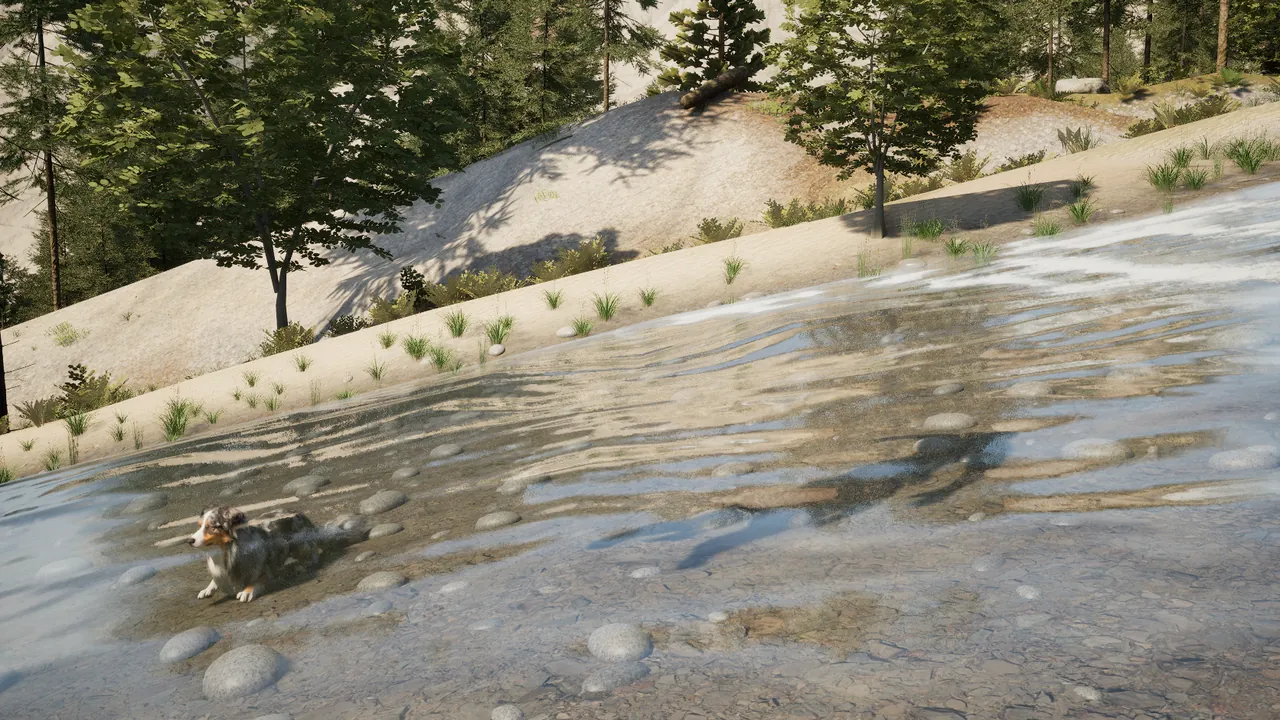
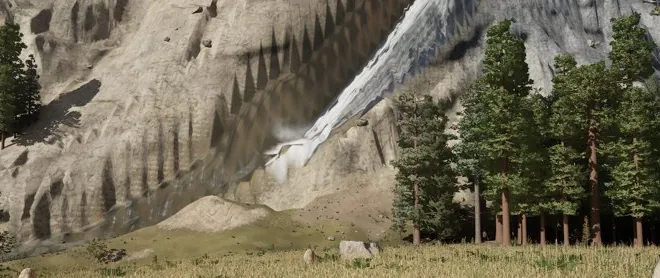
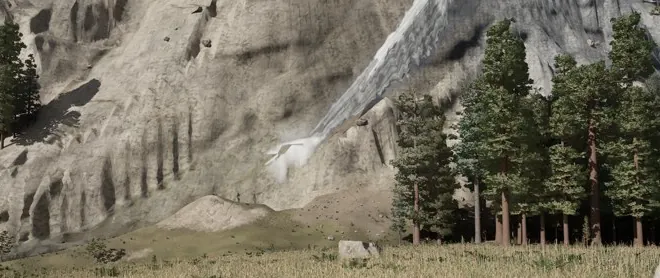
The map kept leaking onto the walls. From 110 m out, far shrubs and their shadows are drawn as a pattern laid from above. On a slope it stretches down the fall line: on a granite bank across a meadow, round 0.5 m crowns became dark ovals and their evening shadows long slashes. Since November 11 the pattern gives way to a plain average on steep ground. A band of dark saw-teeth beside the falls behind the start camp, one tooth per 4 m cell, was traced on November 13. Wetness is stored per grid point, and the falls’ water level, spread across each cell, drew a tall wet tooth in each. It now fades out between 35 and 55 degrees of slope. The tan band the teeth had covered was first put down to the waterfall’s own wet rock. It was riverbank sand painted up the wall, and sand now sheds from steep rock.
Clean was not the same as right. Back on November 6 one wall still read as a big smooth blue-gray face with scribbly dark streaks. That day the big walls began taking their ledges, sheets and chutes from lidar surveys of real Yosemite walls, 64 different faces. By November 8 four attempts to paint sheets onto the far walls had each been judged worse: they read as drawn contour lines. So the structure was measured on a lidar survey of Tenaya Lake. On granite steeper than 18 degrees a sheet edge stands every 12 m and is 1.3 m high. A point every 4 m cannot hold that, so on November 9 steep bare rock in the far view got a finer 2 m skin that carries the lidar relief.
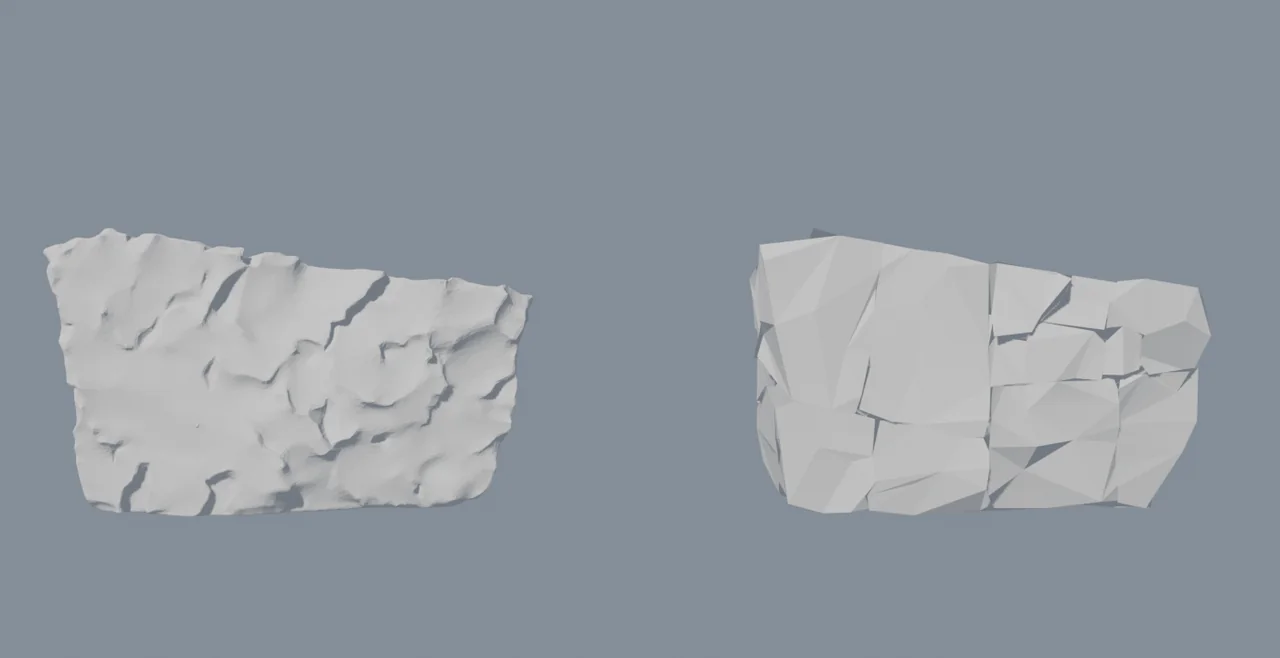
On November 14 scans of real cliff were set into a wall as panels. One test had them facing into the rock. Turned round, they had to stand about 4 m clear of the wall to hide the grid’s teeth and slots, and at that the camp wall read as one continuous jointed face. They also covered the waterfall, came out grayer than the tan wall, and read as horizontal ledges: the scans are of coastal rock, and Sierra granite is more massive and sheeted. The panels stayed off.
The same day a score was built to judge a wall against the real thing: 75 wall patches from lidar surveys of 9 areas of Yosemite, and 12 crops of public-domain photographs. Five invented walls all fail it.
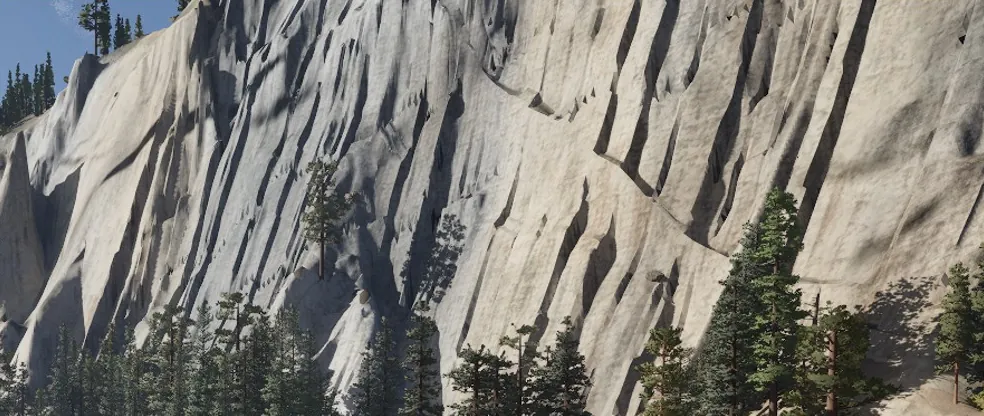
The other approach generated joints into the wall itself: slabs, set-offs and open cracks. An offline render of the bare shape showed crisp joints. The game did not. The camp wall stands 150 to 300 m away, and past 120 m it is the lighter version from November 4, drawn from every second meter point. Columns of 1.5 to 4 m and set-offs of 0.07 to 0.4 m melted into round pits and soft slopes, which the offline render, at full detail, never showed. That distance now keeps every meter point while the relief is on, and the scheme, whose joints had come out as short dashes, was rebuilt around a few long joints that run down the whole face.
Seen in the game later that day, the newest version still read as parallel vertical grooves. It stays off. What reached the build that day was color: steep bare granite went from a warm beige to a cool gray with dark water streaks and a tone for each slab.