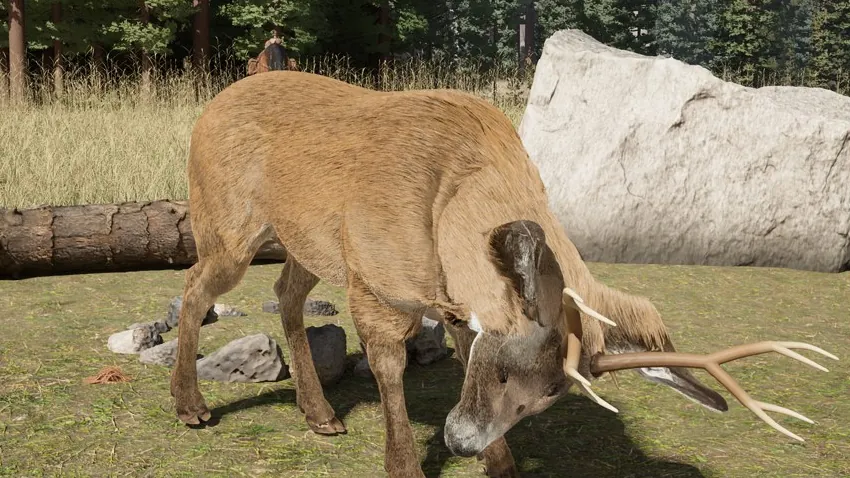
Walk toward a mule deer and it stands, looks and flicks its ears, then walks off long-legged without sinking. Each leg now works as three long segments that turn together, with the hoof flat on the ground, and standing, grazing and dying are motions made on the deer’s own body. The walk is faster, 1.01 m a second where it was 0.79. A playtest had found the deer moving badly: each leg was solved as two bones with the lower leg rigid, so the body sank and the stride was short, and the standing, grazing and dying were horse motions. The skeleton was refitted: the thigh bone had been 13 cm, shorter than a real doe’s, and the tail’s bones ran into the belly. The hind legs now open out and the tail hangs.
The coat’s colors were redone on November 12. The white rump, throat and belly are now whole patches of the coat; before, each hair chose its color alone, which left 28 percent of them as pale flecks. Does are summer tan and bucks winter gray-tan. The near coat and the body drawn past the fur strands now sit close together in color.
Not settled: the doe still reads warm orange in strong sun, and the neck and tail are stiff. Past about 14 m, where the fur strands stop, a deer in sun looked thin and see-through; a fix landed on November 13 without a frame to prove it. The playtest report behind that fix also covered the deer’s animation, and that half is still open.